
Six Aliases, Six Snapshots, One Price: What a Date Suffix Does to an OpenAI API Catalogue
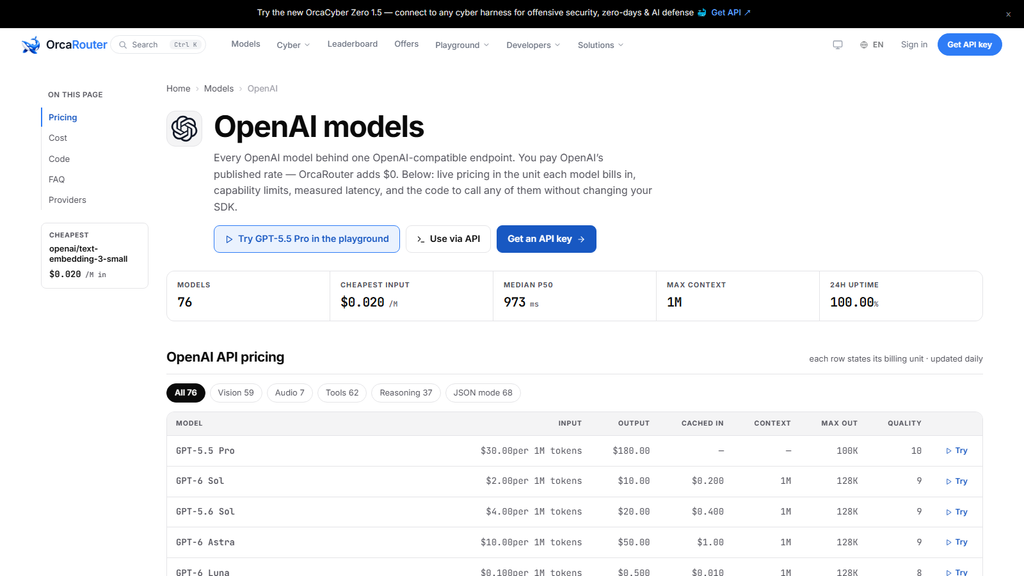
The OrcaRouter OpenAI API page lists 76 rows, and 20 of them carry a date in the model identifier: `openai/gpt-5.4-2026-03-05`, `openai/gpt-5.5-2026-04-23`, `openai/gpt-5-mini-2025-08-07`, and seventeen more in the same shape [OURS]. Six of those dated rows sit next to a plain sibling at exactly the same input and output rate. GPT-5.4 and `gpt-5.4-2026-03-05` are both $2.50 in and $15.00 out per million tokens. GPT-5.4 Pro and `gpt-5.4-pro-2026-03-05` are both $30.00 and $180.00. Same price, same family, same capabilities — and a quality score five points apart.
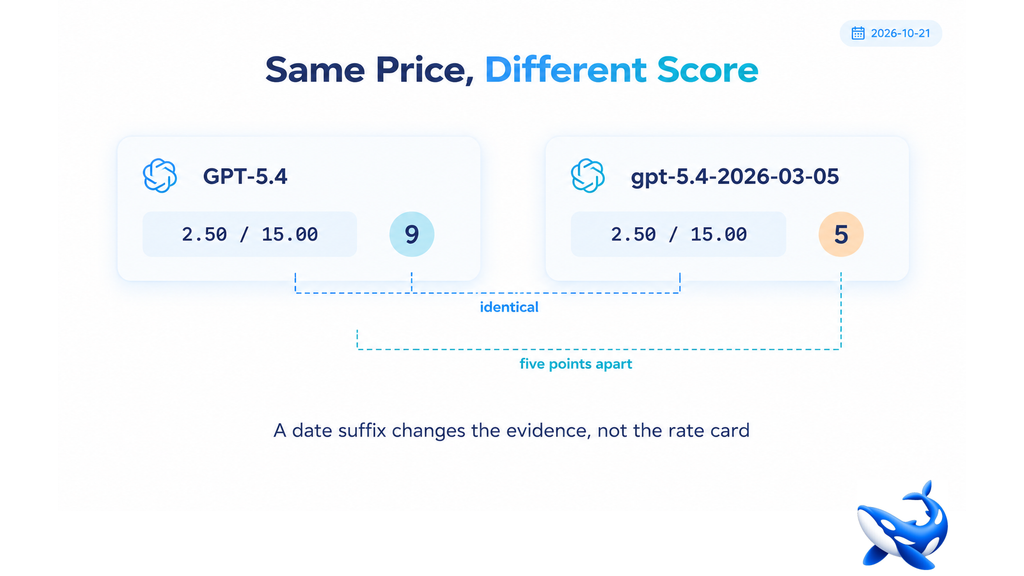
That gap is the subject of this piece, because it is the kind of number a reader is most likely to misuse. A lower score next to an identical price looks like a downgrade. It is not. It is a statement about how much evidence sits behind each row, and once you see how the two rows are constructed, the score stops being a verdict on the model and starts being a note about the row.
The six pairs, stated plainly
Here is the whole set, read off the page on 2026-10-21. Every rate below is the provider’s published rate, passed through with no markup [VENDOR]; the 0-to-10 quality column is our own composite [OURS], not a third-party benchmark.
| Plain identifier | Quality | Dated identifier | Quality | Input / output per 1M |
| GPT-5.4 | 9 | `openai/gpt-5.4-2026-03-05` | 5 | $2.50 / $15.00 |
| GPT-5.4 Mini | 8 | `openai/gpt-5.4-mini-2026-03-17` | 5 | $0.750 / $4.50 |
| GPT-5.4 Nano | 7 | `openai/gpt-5.4-nano-2026-03-17` | 5 | $0.200 / $1.25 |
| GPT-5.4 Pro | 10 | `openai/gpt-5.4-pro-2026-03-05` | 5 | $30.00 / $180.00 |
| GPT-5.5 | 10 | `openai/gpt-5.5-2026-04-23` | 5 | $5.00 / $30.00 |
| GPT-5.5 Pro | 10 | `openai/gpt-5.5-pro-2026-04-23` | 5 | $30.00 / $180.00 |
Six pairs, six rates that match to the cent, six quality differences of four or five points. If you were skimming a pricing table and picked the row with the higher number, you would conclude that the plain identifier is the better model and the dated one is a weaker variant being sold at the same price. That conclusion is wrong, and it is wrong in a specific and checkable way.
What the date suffix is actually for
A frozen snapshot is a promise about reproducibility. Providers version their model weights, and a date in the identifier pins a request to one of those versions so that an evaluation you ran in March still refers to the same thing in October. The plain identifier is a moving target: it points at whatever the provider currently serves under that name, and it is the one you want in production precisely because you want the improvements.
So the two rows are not two products. They are two addresses for the same product line, one of which is nailed down and one of which is not. The rate card does not distinguish between them because the provider does not charge differently for them — the compute is the same compute.
The quality column, on the other hand, is a measurement, and a measurement needs inputs. Ours is a composite built from our own quality dimensions rather than lifted from a benchmark suite [OURS]. A plain identifier accrues evidence continuously: every request that lands on it, every evaluation it appears in, every comparison against a sibling feeds the score. A dated snapshot accrues much less, because fewer people call it by that name. When the evidence thins, the composite does not silently keep the old value; it reports a lower number, which is what a conservative composite should do.
That is the whole mechanism. The five-point gap is a statement about sample size, not about capability.
Why printing the same score would be worse
There is a tempting fix here: copy the plain row’s score onto its dated twin, since they are the same model. It would make the table look tidier and it would be a mistake.
A composite score is a claim that a number is supported by evidence. If the evidence behind the dated row is thin, then printing a 9 or a 10 on it asserts something we cannot back up. The row would then look equally trustworthy to a reader who never checks how either number was produced, and the first person to run a controlled comparison and find a difference would be justified in distrusting the whole column.
Reporting the lower number is the honest option, and it has a second benefit: it makes the distinction visible. A table where the alias reads 9 and the snapshot reads 5 forces the reader to ask why, and the answer — one moving target, one pinned copy — is the thing worth knowing.
What this means when you are choosing a row
Three practical consequences, in the order they are likely to bite.
First, do not treat the quality column as a model ranking across identifier shapes. Within a shape it is comparable: GPT-5.4 at 9 against GPT-4.1 at 4 tells you something real about the two families. Across shapes it is measuring two different things, because one row has a production traffic sample and the other does not.
Second, the cheap way to get a snapshot’s behaviour is not to call the snapshot. If you want reproducibility, pin the dated identifier in a test harness and keep the plain one in production. You will pay the same rate either way — the six pairs above prove it, since every one of them matches to the cent — but you will be calling the moving target where traffic matters and the fixed point where repeatability matters.
Third, watch the context column, not the score, when you migrate. Four of the six pairs are identical on every column that matters — GPT-5.4 and its snapshot both read 1M context and 128K max output; GPT-5.4 Pro and its snapshot both read 1M and 128K; GPT-5.5 and its snapshot both leave the context column blank and read 128K; GPT-5.5 Pro and its snapshot both leave it blank and read 100K. Two pairs do not: GPT-5.4 Mini and its snapshot share the $0.750 / $4.50 rate and the 128K output ceiling, but the plain row carries a 400K context window and the dated row carries a dash, and the same split appears between GPT-5.4 Nano and its snapshot at $0.200 / $1.25.
A dash is not zero and it is not an error; it means the column has no value for that row. Still, it is the sort of difference that turns a confident migration into an afternoon of debugging, because a client that reads the context column to size its chunks will find nothing to read. The pair check catches it in ten seconds: put the two rows side by side, and if any column other than quality differs, treat the dated identifier as a different endpoint rather than a pinned copy of the same one.
The rows that are not pairs at all
Twelve of the twenty dated rows have no plain sibling on the page, and they are worth separating from the six above because they behave differently.
`openai/gpt-5.2-pro-2025-12-11` scores 10, matching the plain GPT-5.2 Pro at 10 — a pair that agrees completely, price and score alike, at $21.00 and $168.00. `openai/gpt-5.2-2025-12-11` scores 9, matching GPT-5.2 at 9. `openai/gpt-5.1-2025-11-13` scores 8, matching GPT-5.1 at 8. `openai/gpt-5-pro-2025-10-06` scores 8, matching GPT-5 Pro at 8. `openai/gpt-5-mini-2025-08-07` scores 7, matching GPT-5 Mini at 7. `openai/gpt-5-2025-08-07` scores 7, matching GPT-5 at 7.
Six dated rows that agree with their plain sibling to the point, and six that do not. The pattern is not random: the agreeing set is older (2025 dates, and two 2026 ones for the 5.2 family), and the disagreeing set is the most recent generation. Whatever the mechanism, the practical lesson is the same one, and it is the reason this article leads with the pairs rather than the rule: read the row, not the pattern.
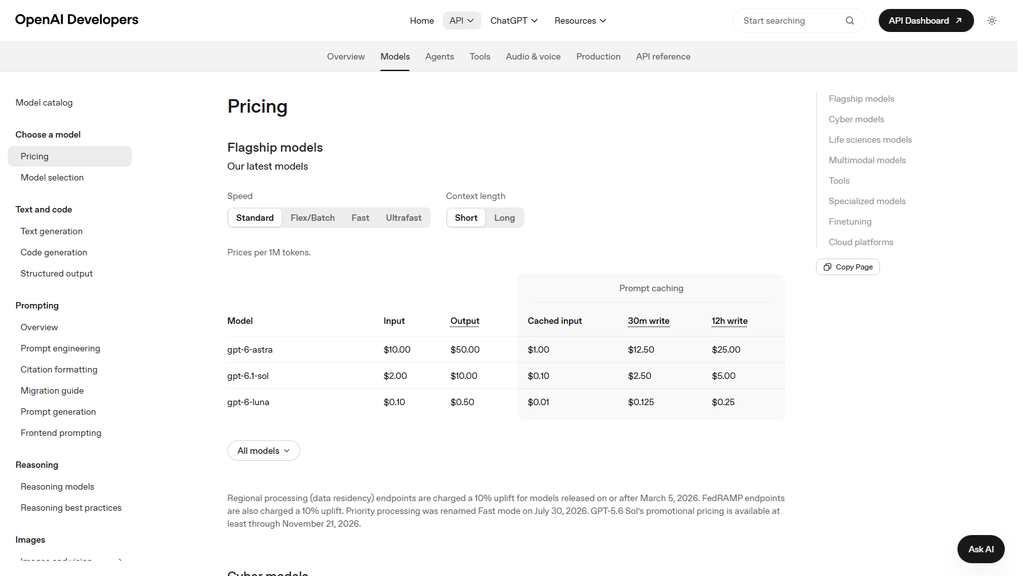
The remaining dated rows — `gpt-5-nano-2025-08-07` at 4, `gpt-4.1-mini-2025-04-14` at 4, `gpt-4.1-2025-04-14` at 4, `gpt-4.1-nano-2025-04-14` at 2, `gpt-4o-mini-tts-2025-03-20` and its December twin at 2, `gpt-4-turbo-2024-04-09` at 2 — include four chat rows that are not among the cheapest on the page. The floor of the whole catalogue is not in this set at all: it is `openai/text-embedding-3-small` at $0.020 per million input, an embedding model, and below GPT-4.1 Nano’s $0.100 sit GPT-5 Nano and GPT-6 Luna at $0.050 and $0.100 respectively. That ordering is a different story and it belongs to a different article.
The takeaway
A price column and a quality column answer different questions, and this catalogue puts them next to each other in a way that makes the difference easy to miss. Six rows charge the same rate and report scores four to five points apart, and the only thing separating them is whether the identifier names a moving target or a frozen copy.
Read the table as a rate card and it is simple: two tiers of that family cost the same per million tokens no matter which address you use. Read it as an evidence ledger and it is telling you which rows have been exercised and which have not. Both readings are correct, and the mistake worth avoiding is taking the second reading as a statement about the first.
Sourcing note: all rates, context windows, max-output values and row counts are read from the OrcaRouter OpenAI provider page on 2026-10-21, where they are the provider’s published rate passed through with $0 markup [VENDOR], and the catalogue structure is ours [OURS]. The 0-to-10 quality scores are our own composite built from our own quality dimensions, not a third-party benchmark, and are not comparable across identifier shapes. No third-party evaluation figures are used in this article. Provider rates change; every figure here was checked on 2026-10-21.